🧠🔍 Psychological Profile of the Editors and Defenders of the Bhagavad Gita Revision
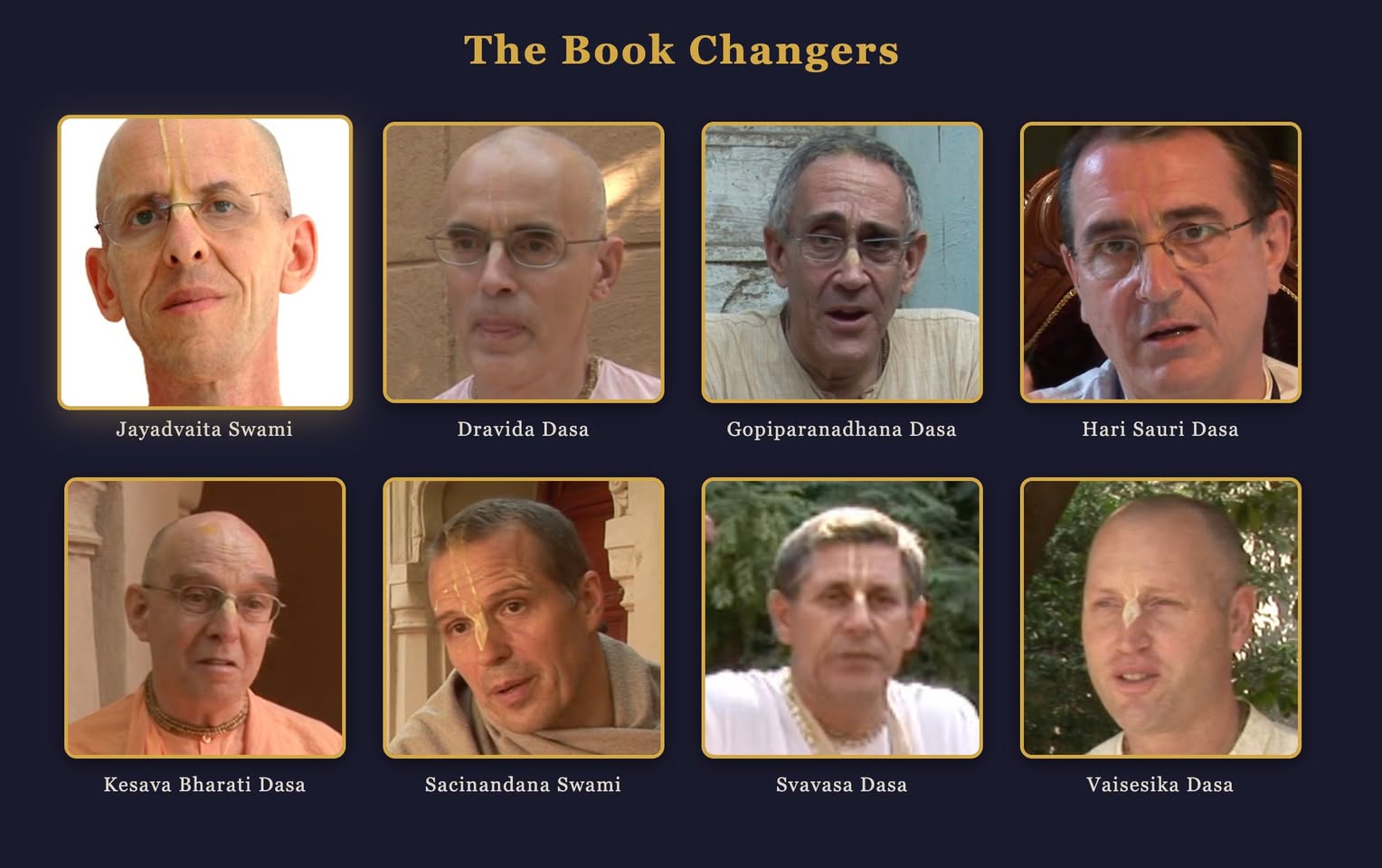
The following observations are drawn exclusively from the arguments of Jayadvaita Swami and others throughout the 19 videos in this series. They are not clinical diagnoses but behavioral patterns that any attentive reader can verify.
1. Grandiosity Disguised as Humility
In Video 12, when Kesava Bharati Dasa (convicted by ISKCON itself as a child abuser) is asked which edition is closer to Prabhupada's intention, his answer is: he personally "hears Prabhupada's intention more clearly" in his own revision, and it "feels empowered and enlivened." This is not an editorial argument. It is a claim to privileged spiritual perception. He is saying, in effect, that he can perceive what Prabhupada truly meant better than Prabhupada's own published text communicates it. In Video 9, Gopiparanadhana Dasa goes further: "the second edition is more original than the first." The person who revised the book declares his revision more authentic than the author's own edition. This is grandiosity presented as devotional service.
2. Contempt for the Predecessor
The entire revision project is built on an unstated premise: that Hayagriva, Prabhupada's original editor, did a poor job. In Video 9, Gopiparanadhana Dasa describes Hayagriva as someone who "crossed out what he couldn't decipher." In Video 17, Hari Sauri Dasa explains the early editorial process as inadequate, with Prabhupada having to leave his work "in the hands of his disciples" because "he didn't have time" to review it. In Video 19, Jayadvaita Swami's contempt becomes explicit: "The Blessed Lord" is attributed directly to Hayagriva by name, as if identifying the source were sufficient to delegitimize the phrase. The implication is consistent: the original editorial work was deficient, and only the current editor can correct it. What is never acknowledged is that Prabhupada used the product of Hayagriva's work for five years without demanding a revision. Contempt for the predecessor is the emotional engine driving the project. For most of the series it remains implicit, but in Jayadvaita's Video 19 it surfaces openly: Hayagriva is named, blamed, and overruled.
3. Inversion of Accountability
A consistent pattern throughout the videos is the inversion of who must justify what. In Video 7, the editor offers to "change it back if evidence arises," as if the author-approved original text must now prove its validity against the revision. In Video 4, those who object to the changes are characterized as conspiracy theorists. In Video 14, defenders of the original text are called "fanatics." The person who altered 77% of a deceased author's book positions himself as the reasonable moderate, while those who say "don't change the author's published work" are the extremists. This inversion of accountability is psychologically revealing: it is the posture of someone who knows his position is difficult to defend and therefore must preemptively discredit those who question it.
4. Authority Without Limits
In Video 11, his argument is explicit: "editors by definition revise." Being appointed editor, in his view, constitutes blanket authorization for unlimited revision in perpetuity, even after the author's death. In Video 5, the argument extends further: since Prabhupada "never told them to stop editing," the editorial mandate is eternal. In Video 15, Prabhupada's acceptance of minor typographical corrections to the First Canto is extrapolated as authorization to revise 541 verses of the Bhagavad-gita. The pattern is one of progressive expansion: a narrow, specific authorization is stretched to cover unlimited scope. This is the behavior of someone who has assumed authority and then seeks justification retroactively, not of someone who received a clear mandate and is executing it.
5. Inability to Distinguish Himself from the Author
In Video 12, the editor states that his revision "feels empowered." In Video 9, he declares it "more original than the first." In Video 8, meaning-altering changes are defended as "restoration of Prabhupada's original intention." Throughout the entire series, there is no moment of doubt, no acknowledgment that the editor's perception of Prabhupada's intention might differ from Prabhupada's actual intention. Video 19 provides the most revealing formulation: "I felt justified in restoring it." Not "the evidence required it." Not "the manuscript demanded it." He felt justified. The basis for changing a sacred text is a personal feeling. The boundary between what the editor believes Prabhupada meant and what Prabhupada actually published has collapsed. This is psychological fusion: the editor has identified so completely with his role that he can no longer distinguish his own editorial preferences from the author's voice. When he changes a verse, he genuinely believes he is restoring Prabhupada. The possibility that he is substituting himself for Prabhupada does not seem to occur to him.
6. Minimization as a Defense Mechanism
In Video 1, the 5,000 changes are dismissed as "not impressive" because they include punctuation. In Video 4, Vaisesika Dasa says the change in BG 4.34 is "not particularly" problematic. In Video 7, the change from Visnu form/Visnu platform is "either way." Each individual change is presented as trivial when examined in isolation. But 541 verses is not trivial. The systematic minimization of individual changes serves to prevent the listener from perceiving the cumulative effect. This is a well-documented psychological defense mechanism: if each brick is insignificant, the wall they form somehow doesn't exist.
7. Deflection Through Emotional Framing
When faced with substantive criticism, the response throughout these videos is consistently emotional rather than evidentiary. In Video 8, the rhetorical question is "how dare you" -- directed not at the editor for changing the text, but at critics for objecting. In Video 14, critics are characterized as people who "shoot off in some direction" and are "totally unreasonable." In Video 5, engaging with textual evidence is dismissed as "nitpicking." The pattern is to deflect discussion from evidence (what was changed, why, and whether it matches the manuscript) toward emotion (loyalty, faith, empowerment, fanaticism). This is the behavior of someone who cannot win the evidentiary argument and therefore refuses to have it.
8. Vagueness Where Precision Is Needed
In Video 16, when asked about the authority for the revision, the answer is remarkably imprecise: "I could see a document where Srila Prabhupada said..." but what the document says is never specified. He describes having sent "some paper or documentation" and hedges: "I don't want to say manuscript." He recalls "a paper or letter or... whatever it was." For someone defending the most significant editorial intervention in the history of his tradition, the inability or unwillingness to cite specific documents with precision is revealing. Either the authorizing evidence does not exist in the form claimed, or the editor has not felt the need to verify it carefully, because the decision was made on other grounds and the documentation is invoked as post-hoc justification.
9. The Psychology of the Fait Accompli
Perhaps the most important observation is structural rather than specific to any individual video. The revision was completed and published decades ago. Every argument in this series is a defense of a fait accompli, not a proposal for future action. This fundamentally shapes the psychology: the editor is not asking permission. He is explaining why what he already did was right. This creates a psychological imperative to justify at all costs, because admitting that the revision was unauthorized or unfaithful would require confronting decades of invested identity. The arguments do not need to be logically rigorous because their function is not to persuade through logic. Their function is to provide sufficient rhetorical cover for the editor and his followers to continue believing in the legitimacy of what has already been done.
10. Theological Imprecision Disguised as Academic Rigor
In Video 19, Jayadvaita criticizes Gita Press for using impersonal terms like "Paramatma" and "Parabrahma" and places "Blessed Lord" in the same category. This conflation is theologically illiterate. "Blessed Lord" is a devotional and personal term -- it conveys adoration, sovereignty, and grace. It is the opposite of the impersonal "Parabrahma." The inability or unwillingness to distinguish between a reverential personal address and an impersonal philosophical abstraction suggests that the editor's objection to "Blessed Lord" is not theological at all. It is territorial: Hayagriva chose the phrase, therefore it must go. The theological argument is constructed afterward to rationalize what is fundamentally an act of displacement.
Summary
What emerges from these 19 videos is not the portrait of careful scholars defending their work with evidence. It is the portrait of people who made a consequential decision decades ago, identified their entire spiritual identity with that decision, and now experience any challenge to the revision as a challenge to their own legitimacy. The arguments are not built from evidence toward a conclusion. They begin with the conclusion -- that the revision was correct -- and work backward to find justifications. This explains why the arguments are inconsistent (the original is both deficient enough to require a complete overhaul and sacred enough to invoke Prabhupada's authority), why critics are dismissed rather than engaged, and why subjective impressions of "empowerment" are offered as evidence alongside procedural claims about institutional authority. These are not the arguments of someone seeking truth. They are the arguments of someone defending a position that has become inseparable from their sense of self.
🎬 Videos Cited (with link to the exact moment)
Video 1 — "Why 5,000 changes?"
• "The number doesn't impress me" — https://www.youtube.com/watch?v=jBQoYoridyU&t=79
Video 4 — "Do you have a problem with the change in BG 4.34?"
• "Not particularly... unless one thinks there's a conspiracy" — https://www.youtube.com/watch?v=Y-dt0Pv8eR4&t=18
Video 5 — "Is it appropriate to edit Prabhupada's books after his departure?"
• "I'm convinced that certain disciples are empowered to edit his books" — https://www.youtube.com/watch?v=8kupWFJuyvQ&t=172
• "He never told them to stop editing" — https://www.youtube.com/watch?v=8kupWFJuyvQ&t=184
• "Better than nitpicking about what's original" — https://www.youtube.com/watch?v=8kupWFJuyvQ&t=302
Video 7 — "Why did you change 'Visnu form' to 'Visnu platform'?"
• "Either way" — https://www.youtube.com/watch?v=9m76vZd1rGA&t=24
• "It's not sacred, it's not that serious" — https://www.youtube.com/watch?v=9m76vZd1rGA&t=43
• "What kind of principle is that?" — https://www.youtube.com/watch?v=9m76vZd1rGA&t=94
Video 8 — "Why do some changes seriously alter the meaning?"
• "Is that terrible? Is it sinful?" — https://www.youtube.com/watch?v=3lp8t5AG1vA&t=42
• "How dare you?" — https://www.youtube.com/watch?v=3lp8t5AG1vA&t=48
Video 9 — "Why edit a book already edited and approved?"
• Hayagriva "simply crossed it out with a black marker" — https://www.youtube.com/watch?v=7Px-W57nt4Y&t=53
• "The original is what comes from Prabhupada's mouth, not what was published" — https://www.youtube.com/watch?v=7Px-W57nt4Y&t=123
• "The second edition is more original than the first" — https://www.youtube.com/watch?v=7Px-W57nt4Y&t=143
Video 11 — "Prabhupada opposed changes. Why change?"
• "For practically ten years my prescribed duty was to change" — https://www.youtube.com/watch?v=OX2X_o3OzGg&t=41
• "Editors are people who by definition revise" — https://www.youtube.com/watch?v=OX2X_o3OzGg&t=62
• "Somehow Prabhupada trusted me" — https://www.youtube.com/watch?v=OX2X_o3OzGg&t=95
Video 12 — "Which edition do you consider closer to Prabhupada's intention?"
• "What I see is Prabhupada's intention more clearly" — https://www.youtube.com/watch?v=ff9PZ4cA7oM&t=17
• "I hear his intention and that gives me faith... it's empowered" — https://www.youtube.com/watch?v=ff9PZ4cA7oM&t=37
• "The second edition is empowered" — https://www.youtube.com/watch?v=ff9PZ4cA7oM&t=51
Video 13 — "Why did you add to the purport of BG 4.34?"
• "It's not my fault, that's what Prabhupada said" — https://www.youtube.com/watch?v=I8x2qtx_6t4&t=19
• "It's common sense" — https://www.youtube.com/watch?v=I8x2qtx_6t4&t=44
Video 14 — "Shouldn't we simply be faithful and loyal to Prabhupada?"
• "Devotees become fanatics about preserving errors" — https://www.youtube.com/watch?v=RlPqHhmitTo&t=34
• "They make a big mistake themselves" — https://www.youtube.com/watch?v=RlPqHhmitTo&t=76
• "They shoot off in some direction... it's totally unreasonable" — https://www.youtube.com/watch?v=RlPqHhmitTo&t=92
Video 15 — "Does the BBT have authority for posthumous corrections?"
• "The authority comes from Prabhupada's desire that his books be free of errors" — https://www.youtube.com/watch?v=l3AAi9LxjJQ&t=17
• "Prabhupada accepted them without seeing them" — https://www.youtube.com/watch?v=l3AAi9LxjJQ&t=62
• "The idea that the books were frozen is fallacious" — https://www.youtube.com/watch?v=l3AAi9LxjJQ&t=108
Video 16 — "By what authority did Jayadvaita Swami re-edit the Gita?"
• "I could see a document where Srila Prabhupada said..." — https://www.youtube.com/watch?v=lrqpR_tF6ns&t=18
• "Whatever it was, a paper or letter or... I don't want to say manuscript" — https://www.youtube.com/watch?v=lrqpR_tF6ns&t=54
Video 17 — "Did Prabhupada approve all the editing?"
• "Even the best writers need a good editor, Srila Prabhupada included" — https://www.youtube.com/watch?v=uQiA_70ny5I&t=25
• "He didn't look at it again... he didn't have time" — https://www.youtube.com/watch?v=uQiA_70ny5I&t=70
• "He knew there were going to be some mistakes" — https://www.youtube.com/watch?v=uQiA_70ny5I&t=98
Video 19 — "Why did you change 'The Blessed Lord said'?"
https://www.youtube.com/watch?v=rpV54tfQ_O8
Spanish version: https://www.facebook.com/vaisnavasdeespana/posts/pfbid031ouaB9ro8eoTiTa1q91dqxwRxTVAwBqqufte3Bn3YR5VzUsjoSSumasoVfJFuZVJl
The following observations are drawn exclusively from the arguments of Jayadvaita Swami and others throughout the 19 videos in this series. They are not clinical diagnoses but behavioral patterns that any attentive reader can verify.
1. Grandiosity Disguised as Humility
In Video 12, when Kesava Bharati Dasa (convicted by ISKCON itself as a child abuser) is asked which edition is closer to Prabhupada's intention, his answer is: he personally "hears Prabhupada's intention more clearly" in his own revision, and it "feels empowered and enlivened." This is not an editorial argument. It is a claim to privileged spiritual perception. He is saying, in effect, that he can perceive what Prabhupada truly meant better than Prabhupada's own published text communicates it. In Video 9, Gopiparanadhana Dasa goes further: "the second edition is more original than the first." The person who revised the book declares his revision more authentic than the author's own edition. This is grandiosity presented as devotional service.
2. Contempt for the Predecessor
The entire revision project is built on an unstated premise: that Hayagriva, Prabhupada's original editor, did a poor job. In Video 9, Gopiparanadhana Dasa describes Hayagriva as someone who "crossed out what he couldn't decipher." In Video 17, Hari Sauri Dasa explains the early editorial process as inadequate, with Prabhupada having to leave his work "in the hands of his disciples" because "he didn't have time" to review it. In Video 19, Jayadvaita Swami's contempt becomes explicit: "The Blessed Lord" is attributed directly to Hayagriva by name, as if identifying the source were sufficient to delegitimize the phrase. The implication is consistent: the original editorial work was deficient, and only the current editor can correct it. What is never acknowledged is that Prabhupada used the product of Hayagriva's work for five years without demanding a revision. Contempt for the predecessor is the emotional engine driving the project. For most of the series it remains implicit, but in Jayadvaita's Video 19 it surfaces openly: Hayagriva is named, blamed, and overruled.
3. Inversion of Accountability
A consistent pattern throughout the videos is the inversion of who must justify what. In Video 7, the editor offers to "change it back if evidence arises," as if the author-approved original text must now prove its validity against the revision. In Video 4, those who object to the changes are characterized as conspiracy theorists. In Video 14, defenders of the original text are called "fanatics." The person who altered 77% of a deceased author's book positions himself as the reasonable moderate, while those who say "don't change the author's published work" are the extremists. This inversion of accountability is psychologically revealing: it is the posture of someone who knows his position is difficult to defend and therefore must preemptively discredit those who question it.
4. Authority Without Limits
In Video 11, his argument is explicit: "editors by definition revise." Being appointed editor, in his view, constitutes blanket authorization for unlimited revision in perpetuity, even after the author's death. In Video 5, the argument extends further: since Prabhupada "never told them to stop editing," the editorial mandate is eternal. In Video 15, Prabhupada's acceptance of minor typographical corrections to the First Canto is extrapolated as authorization to revise 541 verses of the Bhagavad-gita. The pattern is one of progressive expansion: a narrow, specific authorization is stretched to cover unlimited scope. This is the behavior of someone who has assumed authority and then seeks justification retroactively, not of someone who received a clear mandate and is executing it.
5. Inability to Distinguish Himself from the Author
In Video 12, the editor states that his revision "feels empowered." In Video 9, he declares it "more original than the first." In Video 8, meaning-altering changes are defended as "restoration of Prabhupada's original intention." Throughout the entire series, there is no moment of doubt, no acknowledgment that the editor's perception of Prabhupada's intention might differ from Prabhupada's actual intention. Video 19 provides the most revealing formulation: "I felt justified in restoring it." Not "the evidence required it." Not "the manuscript demanded it." He felt justified. The basis for changing a sacred text is a personal feeling. The boundary between what the editor believes Prabhupada meant and what Prabhupada actually published has collapsed. This is psychological fusion: the editor has identified so completely with his role that he can no longer distinguish his own editorial preferences from the author's voice. When he changes a verse, he genuinely believes he is restoring Prabhupada. The possibility that he is substituting himself for Prabhupada does not seem to occur to him.
6. Minimization as a Defense Mechanism
In Video 1, the 5,000 changes are dismissed as "not impressive" because they include punctuation. In Video 4, Vaisesika Dasa says the change in BG 4.34 is "not particularly" problematic. In Video 7, the change from Visnu form/Visnu platform is "either way." Each individual change is presented as trivial when examined in isolation. But 541 verses is not trivial. The systematic minimization of individual changes serves to prevent the listener from perceiving the cumulative effect. This is a well-documented psychological defense mechanism: if each brick is insignificant, the wall they form somehow doesn't exist.
7. Deflection Through Emotional Framing
When faced with substantive criticism, the response throughout these videos is consistently emotional rather than evidentiary. In Video 8, the rhetorical question is "how dare you" -- directed not at the editor for changing the text, but at critics for objecting. In Video 14, critics are characterized as people who "shoot off in some direction" and are "totally unreasonable." In Video 5, engaging with textual evidence is dismissed as "nitpicking." The pattern is to deflect discussion from evidence (what was changed, why, and whether it matches the manuscript) toward emotion (loyalty, faith, empowerment, fanaticism). This is the behavior of someone who cannot win the evidentiary argument and therefore refuses to have it.
8. Vagueness Where Precision Is Needed
In Video 16, when asked about the authority for the revision, the answer is remarkably imprecise: "I could see a document where Srila Prabhupada said..." but what the document says is never specified. He describes having sent "some paper or documentation" and hedges: "I don't want to say manuscript." He recalls "a paper or letter or... whatever it was." For someone defending the most significant editorial intervention in the history of his tradition, the inability or unwillingness to cite specific documents with precision is revealing. Either the authorizing evidence does not exist in the form claimed, or the editor has not felt the need to verify it carefully, because the decision was made on other grounds and the documentation is invoked as post-hoc justification.
9. The Psychology of the Fait Accompli
Perhaps the most important observation is structural rather than specific to any individual video. The revision was completed and published decades ago. Every argument in this series is a defense of a fait accompli, not a proposal for future action. This fundamentally shapes the psychology: the editor is not asking permission. He is explaining why what he already did was right. This creates a psychological imperative to justify at all costs, because admitting that the revision was unauthorized or unfaithful would require confronting decades of invested identity. The arguments do not need to be logically rigorous because their function is not to persuade through logic. Their function is to provide sufficient rhetorical cover for the editor and his followers to continue believing in the legitimacy of what has already been done.
10. Theological Imprecision Disguised as Academic Rigor
In Video 19, Jayadvaita criticizes Gita Press for using impersonal terms like "Paramatma" and "Parabrahma" and places "Blessed Lord" in the same category. This conflation is theologically illiterate. "Blessed Lord" is a devotional and personal term -- it conveys adoration, sovereignty, and grace. It is the opposite of the impersonal "Parabrahma." The inability or unwillingness to distinguish between a reverential personal address and an impersonal philosophical abstraction suggests that the editor's objection to "Blessed Lord" is not theological at all. It is territorial: Hayagriva chose the phrase, therefore it must go. The theological argument is constructed afterward to rationalize what is fundamentally an act of displacement.
Summary
What emerges from these 19 videos is not the portrait of careful scholars defending their work with evidence. It is the portrait of people who made a consequential decision decades ago, identified their entire spiritual identity with that decision, and now experience any challenge to the revision as a challenge to their own legitimacy. The arguments are not built from evidence toward a conclusion. They begin with the conclusion -- that the revision was correct -- and work backward to find justifications. This explains why the arguments are inconsistent (the original is both deficient enough to require a complete overhaul and sacred enough to invoke Prabhupada's authority), why critics are dismissed rather than engaged, and why subjective impressions of "empowerment" are offered as evidence alongside procedural claims about institutional authority. These are not the arguments of someone seeking truth. They are the arguments of someone defending a position that has become inseparable from their sense of self.
🎬 Videos Cited (with link to the exact moment)
Video 1 — "Why 5,000 changes?"
• "The number doesn't impress me" — https://www.youtube.com/watch?v=jBQoYoridyU&t=79
Video 4 — "Do you have a problem with the change in BG 4.34?"
• "Not particularly... unless one thinks there's a conspiracy" — https://www.youtube.com/watch?v=Y-dt0Pv8eR4&t=18
Video 5 — "Is it appropriate to edit Prabhupada's books after his departure?"
• "I'm convinced that certain disciples are empowered to edit his books" — https://www.youtube.com/watch?v=8kupWFJuyvQ&t=172
• "He never told them to stop editing" — https://www.youtube.com/watch?v=8kupWFJuyvQ&t=184
• "Better than nitpicking about what's original" — https://www.youtube.com/watch?v=8kupWFJuyvQ&t=302
Video 7 — "Why did you change 'Visnu form' to 'Visnu platform'?"
• "Either way" — https://www.youtube.com/watch?v=9m76vZd1rGA&t=24
• "It's not sacred, it's not that serious" — https://www.youtube.com/watch?v=9m76vZd1rGA&t=43
• "What kind of principle is that?" — https://www.youtube.com/watch?v=9m76vZd1rGA&t=94
Video 8 — "Why do some changes seriously alter the meaning?"
• "Is that terrible? Is it sinful?" — https://www.youtube.com/watch?v=3lp8t5AG1vA&t=42
• "How dare you?" — https://www.youtube.com/watch?v=3lp8t5AG1vA&t=48
Video 9 — "Why edit a book already edited and approved?"
• Hayagriva "simply crossed it out with a black marker" — https://www.youtube.com/watch?v=7Px-W57nt4Y&t=53
• "The original is what comes from Prabhupada's mouth, not what was published" — https://www.youtube.com/watch?v=7Px-W57nt4Y&t=123
• "The second edition is more original than the first" — https://www.youtube.com/watch?v=7Px-W57nt4Y&t=143
Video 11 — "Prabhupada opposed changes. Why change?"
• "For practically ten years my prescribed duty was to change" — https://www.youtube.com/watch?v=OX2X_o3OzGg&t=41
• "Editors are people who by definition revise" — https://www.youtube.com/watch?v=OX2X_o3OzGg&t=62
• "Somehow Prabhupada trusted me" — https://www.youtube.com/watch?v=OX2X_o3OzGg&t=95
Video 12 — "Which edition do you consider closer to Prabhupada's intention?"
• "What I see is Prabhupada's intention more clearly" — https://www.youtube.com/watch?v=ff9PZ4cA7oM&t=17
• "I hear his intention and that gives me faith... it's empowered" — https://www.youtube.com/watch?v=ff9PZ4cA7oM&t=37
• "The second edition is empowered" — https://www.youtube.com/watch?v=ff9PZ4cA7oM&t=51
Video 13 — "Why did you add to the purport of BG 4.34?"
• "It's not my fault, that's what Prabhupada said" — https://www.youtube.com/watch?v=I8x2qtx_6t4&t=19
• "It's common sense" — https://www.youtube.com/watch?v=I8x2qtx_6t4&t=44
Video 14 — "Shouldn't we simply be faithful and loyal to Prabhupada?"
• "Devotees become fanatics about preserving errors" — https://www.youtube.com/watch?v=RlPqHhmitTo&t=34
• "They make a big mistake themselves" — https://www.youtube.com/watch?v=RlPqHhmitTo&t=76
• "They shoot off in some direction... it's totally unreasonable" — https://www.youtube.com/watch?v=RlPqHhmitTo&t=92
Video 15 — "Does the BBT have authority for posthumous corrections?"
• "The authority comes from Prabhupada's desire that his books be free of errors" — https://www.youtube.com/watch?v=l3AAi9LxjJQ&t=17
• "Prabhupada accepted them without seeing them" — https://www.youtube.com/watch?v=l3AAi9LxjJQ&t=62
• "The idea that the books were frozen is fallacious" — https://www.youtube.com/watch?v=l3AAi9LxjJQ&t=108
Video 16 — "By what authority did Jayadvaita Swami re-edit the Gita?"
• "I could see a document where Srila Prabhupada said..." — https://www.youtube.com/watch?v=lrqpR_tF6ns&t=18
• "Whatever it was, a paper or letter or... I don't want to say manuscript" — https://www.youtube.com/watch?v=lrqpR_tF6ns&t=54
Video 17 — "Did Prabhupada approve all the editing?"
• "Even the best writers need a good editor, Srila Prabhupada included" — https://www.youtube.com/watch?v=uQiA_70ny5I&t=25
• "He didn't look at it again... he didn't have time" — https://www.youtube.com/watch?v=uQiA_70ny5I&t=70
• "He knew there were going to be some mistakes" — https://www.youtube.com/watch?v=uQiA_70ny5I&t=98
Video 19 — "Why did you change 'The Blessed Lord said'?"
https://www.youtube.com/watch?v=rpV54tfQ_O8
Spanish version: https://www.facebook.com/vaisnavasdeespana/posts/pfbid031ouaB9ro8eoTiTa1q91dqxwRxTVAwBqqufte3Bn3YR5VzUsjoSSumasoVfJFuZVJl